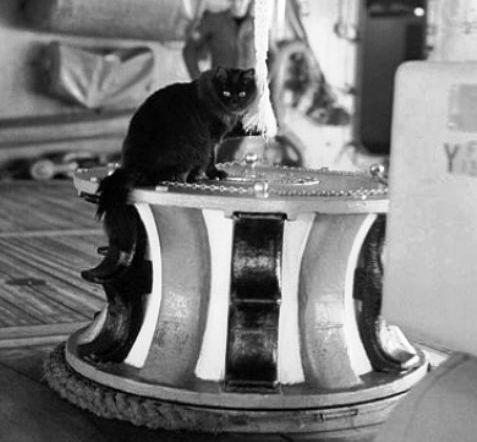
The solution seems obvious, right? Get some cats! But there was a problem. Any kitten born at the yard was immediately scooped up by sailors. A cat on a ship was considered a furry good-luck charm, so the yard’s feline population was constantly being shipped out to sea. That is, until a few clever cats decided to trade a life on the ocean waves for a permanent gig on solid ground. And what a gig it was.

These feline pioneers hid from the sailors, settled in, and got to work. By 1900, the Brooklyn Navy Yard had officially gone from a rat-infested nightmare to a cat-patrolled paradise. The cats were so effective that they even got an official decree of protection.
In December 1900, Rear Admiral Francis T. Bowles, the man in charge, issued a strict order: no one was to harm or interfere with the cats. After all, they didn’t cost the government a dime, surviving on scraps from the workers’ lunches. In return, they saved the United States thousands of dollars a year by protecting government property. They weren’t just pets; they were the Navy’s most cost-effective and cuddliest employees.
Meet the Feline All-Stars
This wasn’t just an anonymous army of cats. The yard was home to several bona fide feline celebrities, each with their own territory and personality.
In the electrical building, you’d find the dynamic duo: Tom and Minnie. Tom was a big, brawny enforcer, but Minnie was the real star. Though barely bigger than a kitten, she was considered the best ratter in the world. She was a fearless acrobat, dodging whirling machinery and leaping across entire flights of stairs to land squarely on a rat’s back. One worker even said, "She deserves a gold medal for preserving the property of the United States government."
Over in the rigging loft of Building 8, the veteran partners Jerry and George Dewey held court. Before they arrived, sail maker William L. Cowan had to deal with mice so bold they’d scamper across his hands while he worked. Once Jerry and George were on the job, the rodents vanished. "You have no idea of the change that has taken place there," Cowan told a reporter.

Jerry was a particularly interesting character. He was the only cat who had actually gone to sea and come back, having taken a few trips with the fleet. He also had a habit of disappearing for about a month at a time, but he always returned to his post. One time, a workman tried to "catnap" Jerry to make him a housecat. No dice. Jerry found his way back to the yard the very next day, ready to get back to work.
Then there was Joan of Arc, the so-called “Republican cat” from Omaha who worked in the ship carpenters’ department. Her owner claimed she could “smell a rat just as quick as a Democrat.” The workers in her shop could set their watches by her, as she showed up every day at exactly 11:55 a.m. for her lunch scraps.
And let’s not forget Jennie, a tortoise-shell who worked in the iron plating shop. Jennie was not only an expert ratter but also a dedicated mentor. She had a new litter of kittens every few months, most of whom were destined to become ship mascots. Before they shipped out, Jennie gave each one a masterclass in mousing, demonstrating the proper pounce-and-growl technique before letting her kittens practice on a dead mouse.
Too Much of a Good Thing
The cats ruled the Brooklyn Navy Yard for decades, their population naturally kept in check by sailors continuing the tradition of adopting them as mascots. But after World War II, things started to change. With fewer ships and sailors, the cat colonies exploded. By the 1960s, there were an estimated 1,500 cats on the property.
The Navy, reversing Admiral Bowles's old decree, decided it was time to set traps. But the cats had an ally on the inside: Bill Wade, a former sailor and journeyman at the yard. He made it his mission to patrol the yard and spring the traps, saving countless feline lives. He was so dedicated that he was suspended twice for his actions, but he never stopped.

When the Navy Yard officially closed in 1966, the fate of its massive cat population hung in the balance. Bill Wade teamed up with the Save A Cat League to rescue them, but it was a frantic and complicated effort. While many cats found new homes, a large feral population remained, descendants of the heroic ratters of a bygone era.
The Cat Legacy Lives On
Today, the Brooklyn Navy Yard is a thriving industrial park, home to artists, manufacturers, and even Steiner Studios, one of the largest film studios outside of Hollywood. But the ghosts of its past—both human and feline—remain.
And the tradition of the working cat isn't dead. When Kings County Distillery moved into the historic Paymaster Building, they found themselves with a post-Hurricane Sandy mouse problem. Their solution? They brought in two cats, Carlos and Jeffy, to take charge. Yes, you can visit the distillery today, grab some award-winning whiskey, and maybe even spot a modern-day Navy Yard cat on patrol.

So next time you’re exploring Brooklyn, take a stroll past the Navy Yard. Look at the old buildings and remember the story of the brave, brawny cats who once ruled this historic site, saving the U.S. government a fortune—all for the price of a few lunchtime scraps.