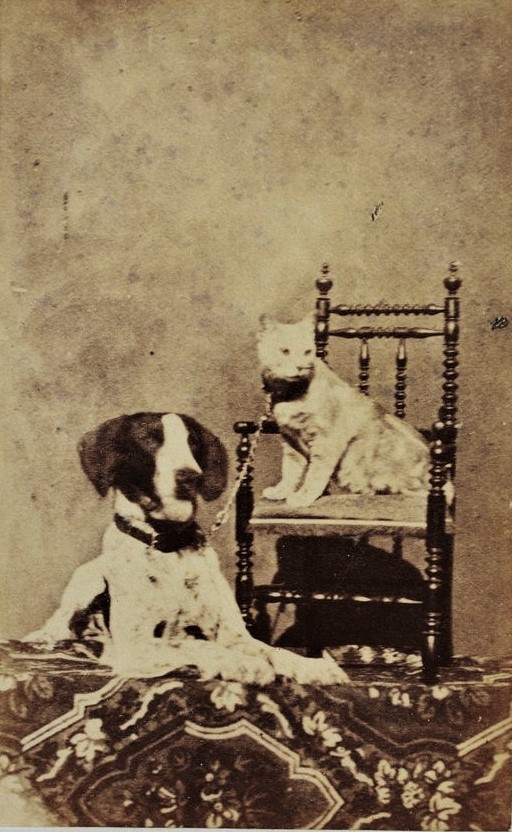
Meet Fanny Jane McAdam, a woman of many names and even more notoriety. Standing over six feet tall with a fiery temper, Jane’s neighbors at her boarding house called her a witch. The police knew her for her lengthy rap sheet. But to her two dogs, Spitz and Flora, and her nine cats, she was simply their protector—the one who fed them, cared for them, and decked them out in some serious 19th-century bling.
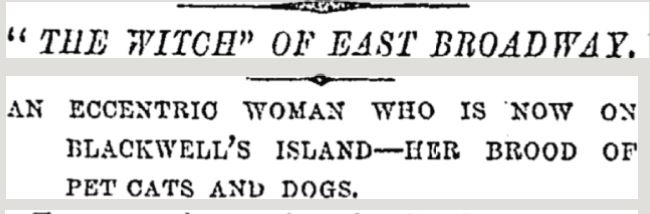
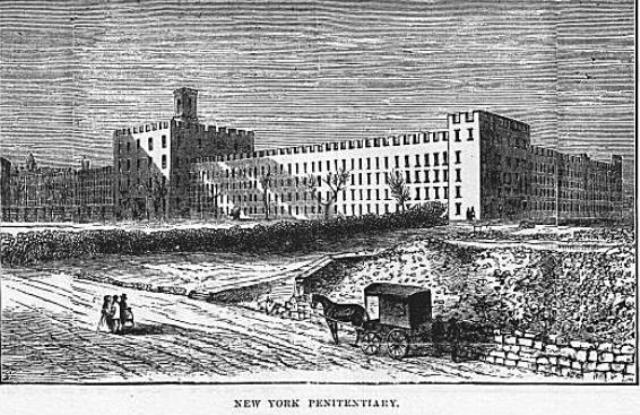
Our story kicks off in February 1879, when Jane's devotion to her pets was put to the ultimate test. After getting arrested for swiping a doormat (yes, a doormat) on West 31st Street, she was sentenced to six months in the penitentiary on Blackwell’s Island, known today as Roosevelt Island.
Panic set in. Not for herself, but for the eleven animals she’d left locked in her attic apartment. From her cell, Jane penned a desperate letter to Henry Bergh, founder of the American Society for the Prevention of Cruelty to Animals (SPCA). She pleaded with him to retrieve the key to her room, promising there was cash inside to pay for her pets’ care.
Meanwhile, back at 101 East Broadway, a chorus of worried howls and meows echoed from the attic. Kind-hearted neighbors, hearing their cries, slid pieces of meat and bowls of water through a small fanlight above the door, keeping the furry crew alive.
Finally, SPCA officers arrived with the key. Accompanied by the police, they opened the door to a scene that must have left them speechless. The room had almost no furniture, just a few sleeping baskets for the animals. But scattered everywhere were trunks filled with silverware, valuable undergarments, stacks of chinaware, and piles of jewelry. And in the midst of this hoard were Spitz the dog, Flora the other dog, and a small army of cats, including four newborn kittens.
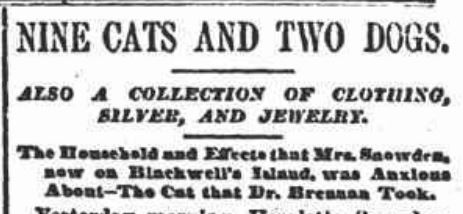
The most astonishing detail? The collars. Spitz, Flora, and the adult cats all wore custom leather collars, ornately decorated with foreign coins. It was a bizarre treasure trove guarded by a well-accessorized group of pets.
As the officers began rounding up the animals, the story took another odd turn. One of Jane’s neighbors, a Dr. Brennan, popped over to adopt one of the adult cats. He complained to the police that Jane’s pets were a “nuisance,” recounting a time when Flora the dog waltzed into his room and stole a pork chop right off his plate. When he kicked the dog out, an enraged Jane burst in and threw an oil lamp at him. His final complaint? The new cat he had just adopted snored too loudly. (You can’t make this stuff up.)
The police quickly realized the mountain of valuables in Jane's room wasn't legally hers. The silverware was traced back to thefts from several high-end locations, including the St. James’ Hotel and the Central Park Garden. When questioned, Jane spun a wild tale of being a world traveler fluent in five languages, claiming three servant girls had paid for their lodging with the silver.
While the fates of the newborn kittens were grimly uncertain, as was common at the time, the dogs and adult cats were taken into the SPCA’s care. Spitz and Flora found safety, and the other cats were placed in baskets—though "not without some very energetic resistance on their part," according to one newspaper. It was even reported that two “fashionably dressed women” visited the SPCA to inquire about adopting the kittens, a small sign of hope.
We don’t know what happened to Jane McAdam after she was released from prison, or if she was ever reunited with her bejeweled companions. But her strange and captivating story lives on.
And what about her infamous residence? The building at 101 East Broadway, once part of a massive colonial farm owned by the Rutgers family (yes, of Rutgers University fame), is still standing. Today, it’s nestled in the bustling heart of Chinatown. So next time you're wandering the Lower East Side, stop by and imagine a time, nearly 150 years ago, when the building's most notorious residents were a pack of cats and dogs dripping with coin-studded collars—a true, hidden gem of New York City's animal history.