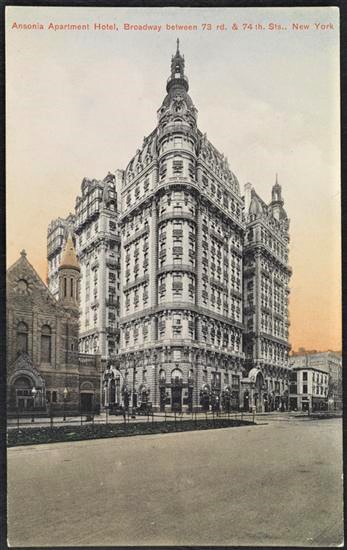

When the Ansonia opened in 1903, it was the definition of over-the-top. But its eccentric owner, William Earle Dodge Stokes, had a dream beyond Turkish baths and air conditioning: he wanted the building to be completely self-sufficient. His solution? A farm in the sky.
Yes, really. On the roof of this grand hotel, Stokes installed what he called “Birdseye View Farm.” It housed up to 500 chickens, numerous ducks, a pig named Nanki-Poo, and even a small bear. For a while, bellhops delivered fresh eggs to residents every morning. The whole operation was quite a sight, until the Health Department got wind of Stokes’s plan to add a cow. In a scene fit for a movie, Stokes and his son snuck the animals down to the basement in the dead of night, just before inspectors arrived. The farm was no more, but the Ansonia’s reputation for animal antics was just beginning.

Soon after the hotel opened, another animal legend was born. It started with a mysterious rapping on the door of Mrs. John Edward Smith’s apartment on the 16th floor. It wasn’t a neighbor; it was a friendly black cat. Ignoring the hotel’s no-pets rule, the Smiths took him in.
But their neighbor, an architect named Louis Eugene Jallade, was not a fan. He ordered a hall boy, Thomas Gill, to get rid of the cat. Gill put the poor feline in a box and took him to Riverside Drive, but the box tumbled down an embankment onto the railroad tracks below. Gill thought he heard a faint meow, but walked away. He assumed that was the end of it.
He was wrong. He should have known: A New York cat always comes back.

The very next day, a ghostly wailing began to echo through the Ansonia. Plaintive meows and scratching sounds seemed to come from inside the very walls of the building, traveling through the hollow spaces built for wiring and ventilation pipes. Tenants on the 10th, 15th, and 16th floors all reported hearing the phantom cries. Even the owner, W.E.D. Stokes, started to worry his brand-new building was haunted. A search party of hotel clerks scoured all 17 floors but found nothing.
The “ghost” finally made a dramatic appearance in the first-floor dining room. As the orchestra leader, Theodore Gordon, was putting away his violin, the black cat—now nicknamed Thomas by the staff—leapt out and clawed his way up the man’s back. Gordon screamed and fled, and Thomas the cat was on the run again.

He was impossibly clever. After startling the musician, Thomas dashed up four flights of stairs and disappeared into an opening for a ventilation shaft. From there, he navigated the building’s complex innards until he found himself in a ceiling alcove right above the apartment of the man who had ordered him thrown out: the architect, Jallade.
A new plan was hatched. A carpenter was called to carefully cut a hole in Jallade’s “beautiful wall.” They placed a bowl of cream just inside the opening, with a wire noose set to snag the hungry cat. The trap worked. A starving Thomas couldn’t resist the treat, and he was finally captured and placed in a champagne basket for transport.
His adventure, however, was about to come to a sad end. Thomas was delivered to the local police station, with a request to send him to the ASPCA. The police refused to hold him, so he spent one last night in the Ansonia’s basement. The next morning, as the New York Times grimly reported, an “ignominious end” awaited him. After ten days of outsmarting an entire hotel, Thomas’s grand adventure was over.
But is it really? Some like to think that Thomas’s spirit earned its “ghost cat” title for good and still roams the elegant, winding halls of the Ansonia today. So, when you pass by, take a moment to look up at its grand Parisian balconies and terracotta details. And maybe, just maybe, listen for the faint, ghostly meow of a cat who once called the most magnificent hotel in New York his own personal playground.