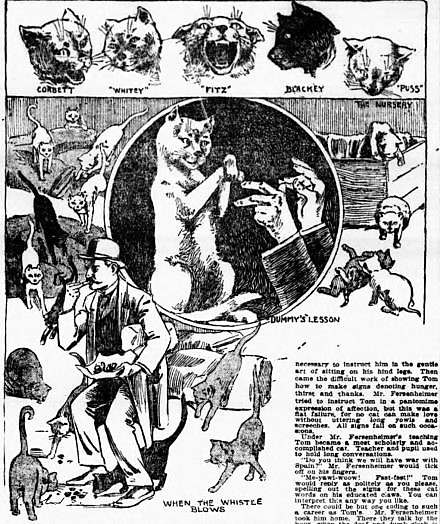
The menu consists of raw calves’ liver and lambs’ kidney, served on clean white paper for 57 patrol cats, two "sergeant" cats, and one bow-legged "roundsman" cat. And the best part? The entire affair was funded by the United States government.
Yes, really. Welcome to the bizarre and wonderful world of New York's official Feline Police Squad.

The Superintendent of Federal Cats
In the early 20th century, the U.S. government actually hired cats to protect mail from the hordes of rats attracted to the glue on envelopes and packages. And in New York, the man in charge of this furry workforce was 81-year-old George Cook. Unofficially, he was the "Superintendent of Federal Cats."
When he wasn't sorting letters, George managed a government budget of about $5 a month to feed nearly a hundred postal mousers. He’d buy meat from a restaurant on nearby Ann Street to serve up a daily meal. This wasn't just a treat; it was a necessity. Without their official rations, the lazier cats had taken to nibbling on leather mailbags and stealing lunches from the clerks.
The Mother of All Postal Cats
The whole dynasty began with a single cat. When the post office moved to its new, palatial home in City Hall Park in 1875, George brought along one female tabby to serve as the building's first official rat-catcher.
There was just one problem. “That darned low critter would never stay on post,” George told reporters. “She used to go a stravagin’ all over town… in a few months there were more cats in this office than letters. Every corner I turned it seemed as if I stumbled on a nest o’ kittens.”
The population exploded. At one point, a supervisor had George stuff six mailbags full of cats and, as George put it, “registered them, yes, mister, an’ sent ‘em to a little post office in New Jersey. Gosh! I wonder what the feller said when he got ‘em.”

Mailing cats to another state didn't quite solve the problem. Strays from nearby restaurants and sparrows from the park also joined the force for a steady job. By 1897, the population was so out of control that the aociety for the Prevention of Cruelty to Animals (SPCA) was called in to thin the herd. Cats with names like Fitzsimmons—a long-legged fellow who could stand on his hind legs—were tragically taken away. But the colony always bounced back.
Life on the Feline Force
Being a postal cat wasn't just about catching rats. It was a whole lifestyle, complete with a career ladder. New "recruits" started in the basement’s newspaper department amid the mailbags and sorting chutes. It was the perfect training ground for a young mouser.

Exceptional performers could earn a "promotion" to the top-floor Registry Division, where the most valuable mail was handled. These were the "first-class cats," and they had to be extra diligent.
The most incredible part of their day was lunchtime. Around 2 p.m., George would blow a whistle, and like a furry tidal wave, cats would pour out from every corner of the vast basement, scrambling over carts and through people’s legs to get to their meal. They even ate in assigned groups, with "boss" cats chasing away anyone who tried to crash their table.
To keep the peace, the elite first-class cats from the top floor had their own dining schedule. They would gather patiently at the elevator, ride it down to the basement for their meal, and then ride it back up to get back to work. You read that right: these cats took the elevator.

In the summer, the cats were even allowed an afternoon break. They’d stroll outside into City Hall Park to sunbathe, catch a few sparrows, and maybe swap stories with the park’s own resident felines before heading back inside to resume their duties.
The End of an Era
By 1910, George Cook was getting on in years, and a younger man, William W. Dixon, had taken over as the "King of the Cats." The feline police force had grown to nearly 200 members across the city, with the main branch still at City Hall Park. But big changes were coming.
A massive new General Post Office—the same one you see today across from Penn Station—was under construction on 8th Avenue. The beautiful old building in City Hall Park, affectionately known as the "Mullet Post Office," was eventually demolished in 1938 to clear space for the park we know today.

After 1924, mentions of New York’s postal cats disappear from the records. Their skills, it seems, were no longer required in the modern, new facility. The era of the government-funded feline police squad was over.
So the next time you’re downtown, take a moment in City Hall Park. Look toward the spot where the old post office once stood, and imagine the sight of a hundred cats taking the elevator to lunch, patrolling the mail, and living a truly unique New York story.