Meet Caroline Ewen, a wealthy heiress who might just be New York’s most legendary “cat lady.”
In the summer of 1904, the Board of Health received a desperate plea from the residents of East 101st Street. The problem? The “nightly concerts” coming from Caroline’s brownstone at number 105. Her neighbors, Jacob Thorman and J. Kaplan, were at their wits' end.
“It is not that we object to Miss Ewan’s humane impulses,” one petition read, “but the noise of her pets is something wonderful. It is enough to drive a strong man… to drink.”
Another neighbor lamented the lack of feline harmony: “There are bass cats and soprano cats, tenor cats and contralto cats, but there is no feline to drill them and make them sing in unison or harmony. I am fond of good music, but I do not consider eighty cats singing in eighty keys and eighty kinds of time good music.”

So, how does one end up with nearly 200 cats in a Manhattan brownstone? It all started with a simple, if unconventional, business proposition.
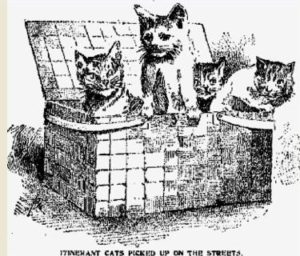
Caroline, who had moved into the house a year earlier with just three cats, made an offer to the neighborhood boys: for every stray, hungry, or homeless feline they brought her, she would pay them ten cents. Yes, a dime a cat. In return, the boys had to pledge to be kind to all living creatures. Some savvy kids tried bringing her well-fed house cats, but Caroline quickly clarified she was only in the market for genuine strays.
Soon, her home was overflowing with what one neighbor called "mangy cats," all being nursed back to health. Caroline’s goal was to reform these "wicked" street cats and find them loving homes. She installed screens on all her windows to keep her furry residents safe. One success story was Dewey, an all-white cat who, under her care, transformed into a well-mannered gentleman who looked like “an admiral on the quarter-deck.”

Caroline’s feline philanthropy wasn’t a new hobby. For years, she was a key member of early animal welfare groups. One of these, cheekily named the "Midnight Band of Mercy," roamed the streets late at night to "save" homeless cats, though their methods, sometimes involving chloroform, were controversial even then. After the group disbanded, Caroline adopted a more direct approach: bringing the cats home with her.
When confronted about the noise, Caroline was unapologetic. She refused to quiet her cats or stop her rescue mission, regardless of what her neighbors thought. Eventually, the Board of Health stepped in and gave her an ultimatum: the cats go, or you go.
Caroline chose to go. “Yes, I expect to move,” she told a reporter. “I shall go somewhere on the West Side, where my friends are, and where people can sympathize with my love for cats. What harm do my cats do anybody?”
She made good on her word, moving first to West 86th Street and later to West 92nd Street—both conveniently close to Central Park, another popular spot for stray cats looking for a free meal.

When Caroline Ewen died in 1913 at age 73, her final act of devotion to animals stunned the city. Being the wealthy daughter of Civil War Brigadier General John Ewen, she had a sizable fortune. Her will stipulated that nearly her entire estate—worth about $300,000 at the time (that’s over $9 million today!)—be donated to humane societies in New York, Boston, London, and beyond.
This massive bequest solidified her legacy as one of the great benefactors of animal welfare, ensuring that her mission would continue long after she was gone.
And the story has a wonderful New York twist. Years later, Caroline’s sister, Eliza, donated a piece of the family’s sprawling Bronx estate to the city. The condition? That it be named Ewen Park in honor of their father. The park was created in 1935, and if you visit it today, you’ll find it has a very fitting feature: a popular dog run right on the site of the former family home.

So, next time you’re exploring East Harlem or walking your dog in the Bronx, take a moment to remember Caroline Ewen. She was a woman whose love for cats was so immense it couldn't be contained by a single brownstone, leaving behind a legacy of compassion—and a story that’s pure New York.