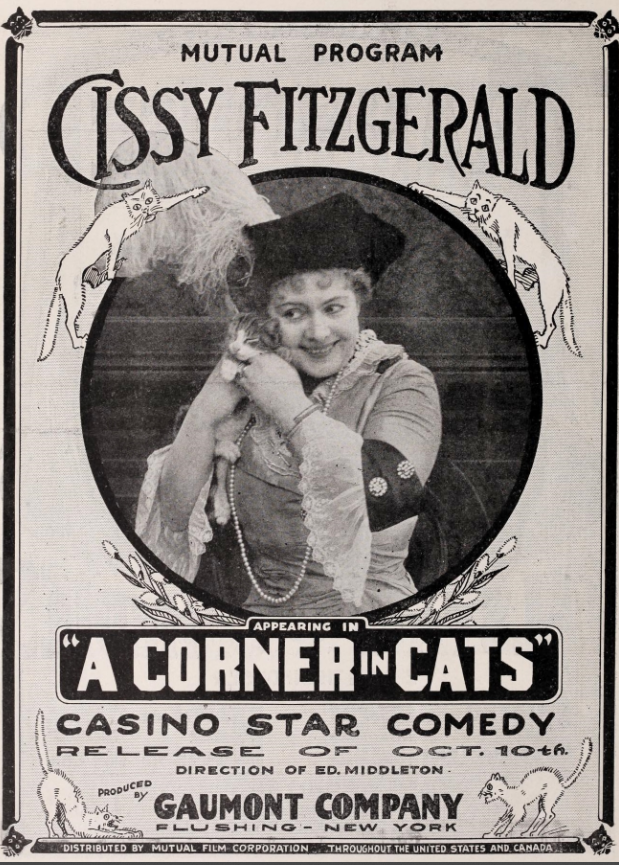
It all started with a silent comedy called “A Corner in Cats.” Director Edwin Middleton, working for the Gaumont Company film studio in Flushing, had a big problem. The plot of his movie called for an entire town overrun with felines, but he was about 100 cats short of a cinematic masterpiece. He had already hired all the available "professional" movie cats in the city, but it wasn't enough.

What’s a director to do? Simple. He put out the word in Flushing: the studio would pay cash for cats. No experience necessary.
As soon as the neighborhood kids heard the Gaumont studio was paying for feline talent, a parade of children appeared at the studio gates on Congress Avenue (known today as 137th Street). They came carrying every stray, alley cat, and neighborhood wanderer they could get their hands on, eager to contribute to the film and earn a little money.
But even with this influx of furry hopefuls, Middleton still needed about 45 more. So, he made a phone call across the river to Manhattan.
His call went to Mrs. Flora Kibbe, the founder of the Bideawee home for animals, then located at 410 East 38th Street in Murray Hill. Mrs. Kibbe was a pioneering animal welfare advocate, and she loved the idea. She agreed to lend the studio 45 of her finest shelter cats, free of charge, with one condition: they had to be returned safe, sound, and ready for adoption after filming wrapped.

And so, in what must have been an incredible sight, "forty-five cats, black, white, yellow, gray, slim and fat, old and young," were loaded into a "big automobile" and chauffeured from their Manhattan shelter to the movie studio in Queens. Can you imagine the chaos on set with over 100 cats, many of whom had never seen a film camera? It must have been glorious madness.
The plot of “A Corner in Cats” was just as wonderfully absurd. Two clever con artists (played by actors Cissy Fitzgerald and Bud Ross) decide to get rich quick. They arrive in a town called Boomopolis, put up a sign offering to buy cats for 50 cents each, and then secretly order 600 rats to be delivered. As the town is overwhelmed by a rodent plague, the panicked townsfolk are suddenly desperate for cats. Our heroes then sell the same cats they just bought back to the citizens for the inflated price of $10 to $15 a pop! In the end, they leave town with their pockets full and adopt a stray kitten they name "Cash."

While the main Gaumont studio was a state-of-the-art facility in Flushing, the company also owned a more mysterious property nearby in College Point that they used for outdoor scenes. And this is where the story takes a fascinating turn.
The company had acquired a 10-acre plot with a sprawling, 24-room mansion that once belonged to a wealthy sea captain named John Graham. Built around 1861, the mansion was perfect for filming, but it held a secret beneath its floors: a series of brick-vaulted tunnels leading from the basement down to the waterfront on Flushing Bay.

No one knows for sure what the tunnels were for. Some whispered they were used by smugglers. A more noble rumor suggested they were a stop on the Underground Railroad, helping enslaved people escape to freedom in Canada. While that was never proven, the timeline fits. Of course, they could have just been for storing produce from the captain's farm. We'll likely never know for sure.
It’s tantalizing to think that “A Corner in Cats,” with its cast of over 100 furry stars, might have been filmed on the grounds of this historic mansion. Imagine the cats chasing each other through rooms that may have once hidden smugglers or freedom seekers!

So, what happened to everyone? The good news is that director Edwin Middleton kept his promise. All the cats, from the Flushing strays to the Bideawee rescues, were safely returned to their owners or the shelter after their brush with fame. The Graham mansion was torn down around 1917, but the mysterious tunnels were rediscovered a decade later when the land was being developed for new homes.
The next time you’re in Flushing or Murray Hill, take a moment to look around. You're walking through a piece of New York’s unwritten animal history—a story of cinematic dreams, secret tunnels, and the day a hundred cats became movie stars.