“American cats. English. Irish. Lithuanian German. Italian and Bohemian cats,” a reporter for the New York World wrote in 1894. “Fat cats, thin cats, black cats, white cats, dirty cats and very dirty cats… all waiting for the never-failing supply of substantial food.”
This wasn't just a random gathering. This was New York's first, and perhaps most charming, open-air cat café, run by two of the city's most dedicated cat ladies.

Meet the Anderson Sisters
The architects of this feline paradise were Miss Clementine and Miss Mary J. Anderson. The two sisters were educated, independently wealthy, and by all accounts, devoted to one thing above all else: the well-being of the neighborhood’s stray cats.
Despite owning property in more "aristocratic localities," the sisters chose to live in their childhood home at 128 Broome Street, on a corner of the Lower East Side then known as “Poverty Hollow.” They lived a quiet life, never marrying, and sharing the home with their brother’s family. But their quiet life had a very public, very furry side-project.

Dinner is Served
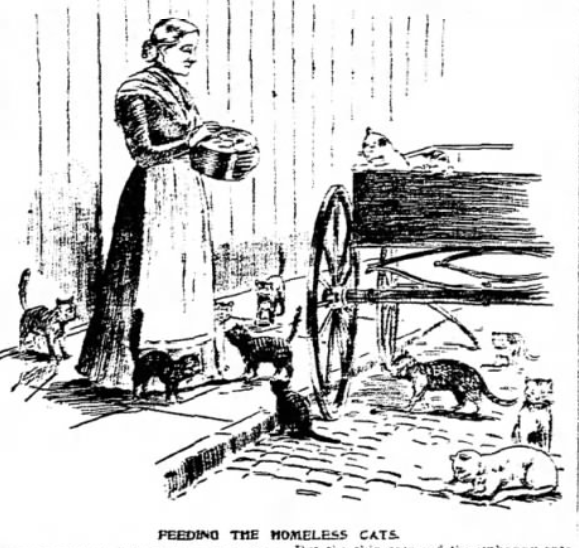
The cats of the Lower East Side knew the Andersons' address by heart. Every day was a two-course affair. For breakfast, the milkman would deliver ten bottles of milk, which the sisters would boil and serve warm. But the main event happened after dark.
A reporter described the nightly scene: "Under the wagons, on the fence, and on the sidewalk would he find cats, cats, cats! Cats everywhere... a peaceful, expectant, comfortable-looking collection of felines."
For dinner, the sisters served a "goodly amount of meat, appropriately cut," dished out right there on the street. This wasn't just a free-for-all, either. The Andersons had a system. They had an uncanny ability to spot a freeloader—a spoiled housecat trying to sneak an extra meal. These greedy kitties would get a gentle tap from a whip and be shooed away, leaving the feast for the truly needy. A growl or a hiss might follow, but the message was clear: this place was for the homeless.
In a neighborhood known for its poverty and grit, the corner of Broome and Pitt was a sanctuary. The only "unhappy cats," the newspaper noted, were the ones who lived too far away to make the daily pilgrimage.
The End of the Cat Mecca
Sadly, this feline paradise couldn't last forever. By the late 1890s, New York was in the midst of a massive transformation, and the Lower East Side was ground zero.
The construction of the Williamsburg Bridge, which began in 1896, completely reshaped the neighborhood. Entire blocks were cleared, old wooden houses were torn down, and massive tenement buildings rose in their place. The Andersons' quaint cottage at 128 Broome Street stood directly in the path of this relentless progress.

By 1903, the Anderson home was gone, replaced by a six-story brick tenement that still stands today. We don’t know what happened to Clementine and Mary, or to their international community of cats. One can only hope the cats found new benefactors as the city roared into the 20th century.
A Piece of History You Can Still See
While the Anderson sisters' home is long gone, you can still find a physical trace of the world they knew. Their neighborhood, Poverty Hollow, sat at the base of a small hill known as Mount Pitt. This hill was leveled in the 1820s to make way for the expanding city grid.
So, where did all that rock go? Some of it was used to build the foundations of local buildings, including a beautiful stone church at 7 Bialystoker Place, just a few blocks from where the sisters fed their cats. Originally a Methodist church, it’s now the magnificent Bialystoker Synagogue.

The next time you’re on the Lower East Side, take a walk past the corner of Broome and Pitt. The old cat mecca is gone, but the story remains. It’s a reminder that even in the toughest corners of New York City, there have always been people—and animals—finding ways to look out for one another. And if you swing by the Bialystoker Synagogue, you can literally touch a piece of the landscape that the international cats of Poverty Hollow once called home.