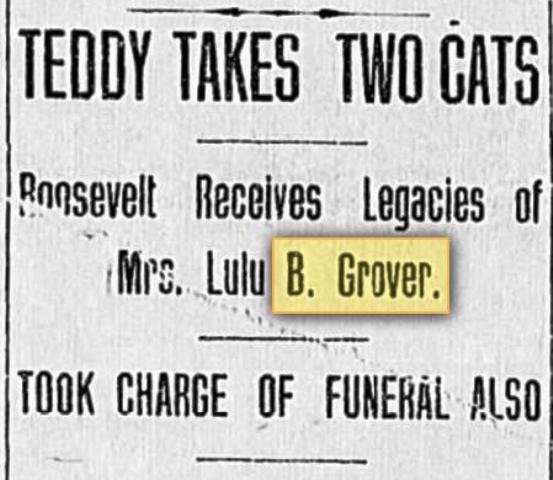
You read that right. Not the police commissioner, not the mayor, but the President of the United States. Why? Because a woman named Lulu Grover had just passed away, and she had bequeathed her most prized possessions to the leader of the free world: her two beloved Angora cats.
This is the strange, sad, and surprisingly sweet story of Lulu Grover, a woman whose obsession with Teddy Roosevelt created one of New York City’s most bizarre historical footnotes.

Lulu Grover was a woman of mystery living at 2089 Lexington Avenue in East Harlem. Around 45 years old and always well-dressed, she told friends she was a magazine writer and artist with a secret income. But her favorite topic was her supposed lifelong friendship with President Theodore Roosevelt. She’d spin tales of riding horses with him on the North Dakota prairies and even claimed to have once sent a shotgun and watch to his son, Teddy Jr., as Christmas gifts. (Roosevelt supposedly wrote back asking the anonymous giver to stop spoiling his boy!)
While her friendship with the president was likely a fantasy, her love for her two white Angora cats was very real. They weren't just any cats; they had names worthy of royalty: Magistrate Joseph Pool and Queen Fairy Snowdrop.
And how did Magistrate Joseph Pool get his name? In one of the most “New York” stories you’ll ever hear, Lulu had a dispute with a neighbor in early 1906. She claimed the neighbor’s dog was scaring her cat, and the neighbor threw water on her. The case ended up in the Harlem Court, where Magistrate Pool took Lulu’s side. To honor the ruling, she promptly named her fluffy companion after him.

By late 1906, however, Lulu’s story took a dark turn. Describing Roosevelt as “her only true friend in trouble,” she wrote a will leaving her entire estate—about $800, some jewels, and the two cats—to the President.
On the night of December 8, she wrote one last letter to Roosevelt, explaining that her will was sewn into the lining of her cat basket. Then, she took her own life.
When police and neighbors entered her apartment, they found Lulu unconscious. But they also found something astonishing: a veritable shrine to Theodore Roosevelt. The walls were covered with pictures of the president, from magazine clippings to three oil paintings Lulu had made herself. Her shelves held a complete collection of his writings.
And in the middle of it all were two very confused Angora cats in their basket.

Lulu passed away at Harlem Hospital the next day. Now, city officials had a problem. The Public Administrator, William M. Hoes, knew what to do with her money and jewels. But the cats? They had been legally willed to the President. He couldn’t just give them away!
So, what’s a president to do when he inherits two cats from a stranger who was disturbingly obsessed with him? Publicly, Roosevelt’s office denied he ever knew Lulu Grover. Privately, however, the famously soft-hearted animal lover made sure her last wishes were honored with surprising tenderness.
Under Roosevelt's secret orders, U.S. District Attorney Henry L. Stimson stepped in. He ensured Lulu was not buried in a pauper’s grave, but was cremated and her ashes interred at the beautiful Woodlawn Cemetery in the Bronx—a place you can still visit today.
And the cats? President Roosevelt told his staff to have them sent to Washington. A carriage arrived at the Lexington Avenue apartment, and Magistrate Joseph Pool and Queen Fairy Snowdrop were chauffeured to the capital, reportedly escorted by the president’s own brother-in-law.

The two Harlem cats joined a bustling White House menagerie that included dogs, ponies, guinea pigs, and another famous cat named Slippers, who had six toes. For two pampered apartment cats, the expansive lawns of the White House must have felt like paradise.
The story has one last bizarre twist. At an auction of Lulu’s belongings a year later, a gold ring was sold containing what the auctioneer claimed was a tooth Teddy Roosevelt had once given Lulu as a keepsake. An antique dealer bought it for $25, hoping to cash in on the strange tale.
So the next time you’re in East Harlem or walking the grounds of Woodlawn Cemetery, think of Lulu Grover and her two cats. It’s a strange and poignant reminder that in New York City, even the most forgotten stories can have a connection to the White House.