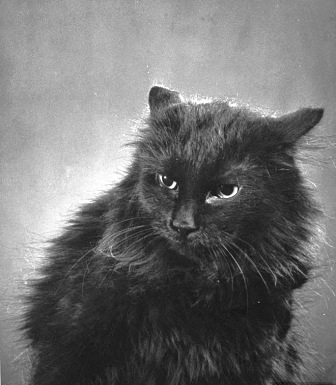
What if the Rangers’ luck ran out when they lost their most important team member: a little black cat named Ranger?
Yes, really. While today’s Rangers are one of the few NHL teams without a mascot, back in the Jazz Age, they had a real-life, four-legged good-luck charm. As one writer for the Brooklyn Daily Eagle put it in 1931, "The love of a man for a dog is as nothing compared to a hockey player’s love for his cat.”

A Mascot Arrives in Midtown
Picture it: the winter of 1927. Outside the brand-new Madison Square Garden on Eighth Avenue, between 49th and 50th Streets, a little black cat was found cold and whimpering by the team’s trainer, Harry Westerby. He brought her into the warmth of the hockey dressing room, and just like that, the team had a new roommate.
When the team manager, Lester Patrick, first saw the cat, he was wary. “Don’t you think a black cat’s unlucky?” he asked. Westerby, unbothered by superstition, simply replied, “Why should it be?” Patrick couldn’t argue, and the cat, now named Ranger, was allowed to stay. It was a decision he’d never regret.

Ranger’s new home was the third version of Madison Square Garden, a massive arena built on a site that was once colonial farmland. She quickly made the place her own. Described as a “fighting hockey cat,” she would snarl and box with other felines, but she saved her charm for the players. And that charm worked like magic.
The Good Luck Charm
With Ranger I prowling the locker room, the Rangers had an unbelievable 1927-28 season. The team, now nicknamed the "Broadway Blueshirts" for their proximity to the Theater District, powered through the playoffs and won the Stanley Cup. Their victory was so electrifying that the players became minor celebrities in the city.
The team was convinced Ranger was their secret weapon. For the next four years, as long as she was there, the Rangers always made it to the playoffs.

Though she lived at the Garden, Ranger remained a bit wild, only letting trainer Harry and a few players get close. She had several litters, but once her kittens were old enough, she’d chase them away. It was as if she knew her role as the one-and-only mascot and wouldn’t tolerate any competition.
A Mascot's Farewell
In January 1931, the unthinkable happened. Ranger suddenly stopped eating. A worried Westerby tried tempting her with milk and raw meat, but she refused. One night, employees found her back at the same steel door where Westerby had first discovered her four years earlier. He rushed to her side, petting her and calling for brandy to ease her passing.
On January 10, 1931, Ranger died. The entire staff of Madison Square Garden, from the players to the ticket-takers, mourned her. The next night, the Rangers lost to the Black Hawks. Team captain Bill Cook told the press, “That’s why we lost… We’d already lost our mascot.”
The team’s luck completely tanked. They went on a losing streak, and their playoff hopes dwindled. The message from the players to management was clear. “You’d better get a new mascot in here in a hurry,” Cook demanded. “If you don’t, I’ll go out on the back fences, looking for one myself.”
The Return of Ranger
Fortunately, they didn’t have to search the alleys of Manhattan. The team’s publicity man, Willis “Jersey” Jones, had adopted one of Ranger I’s kittens. This little cat, dubbed Ranger III, was ready for her moment.
“Ranger III is a carbon copy of the old lady,” Jones told a reporter. “It’s the same fresh kind of a cat – all claws and scratchy disposition. It’s grown up, too… The other day it killed his first mouse.”

The new mascot was put to the test on February 5, 1931. The Rangers were playing their crosstown rivals, the New York Americans, who had their own mascot—a big Newfoundland dog named Pete. After the Rangers won, Ranger III was seen smugly giving herself a bath in the dressing room while poor Pete moped next door.
The curse was broken! The players were fiercely protective of their new charm. “If you step on the cat,” warned player Murray Murdoch after the game, “there’s going to be a couple of dead reporters around here.”
Ranger III held court at the Garden for a few more seasons before mysteriously disappearing one day. No one knows where she went, and no cat ever took her place. After that, the team’s luck seemed to fade, leading to that infamous 54-year championship drought.
So next time you're walking along Eighth Avenue near 49th Street, look at the gleaming skyscrapers and remember that you’re standing on hallowed ground. Not just for hockey, but for a little black cat who, for a few magical years, was the toughest and luckiest New Yorker on ice.