Yes, really. This is the wild story of the Society to Befriend Domestic Animals and how their dream of a feline paradise took a very dark turn.

The Cat-Loving Crusaders
Our story starts with two unforgettable characters who would make any modern-day cat lover proud. First, there was Mrs. Sarah J. Edwards, a widow living in a flat at 125 West 28th Street (today the site of a Cambria Suites hotel in Chelsea). Her apartment was already overflowing with about 20 feline friends who lounged on her piano and sofa.
Then there was Mrs. Grace Georgia Devide, a fiery southern belle from Virginia and the passionate leader of the group. Living in a posh brownstone on West 21st Street, she confessed she had been secretly feeding stray cats since 1875. Her preferred time? Midnight, “when wicked boys are asleep and cruel men are too drunk to use their canes.” This late-night habit would soon become legendary.
Together with a few other animal lovers, they formed the Society to Befriend Domestic Animals (SBDA). Their mission was simple and noble: provide food and shelter for homeless animals and offer a painless death only to those suffering from incurable ailments. But as their popularity grew, things started to get a little out of hand.
A Feline Frenzy in Manhattan
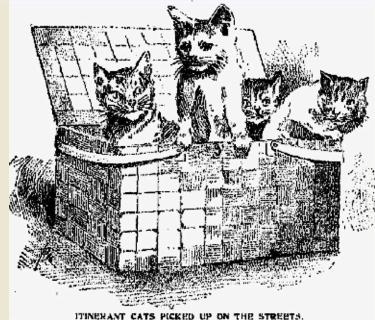
Once newspapers caught wind of their plan to open a "cat asylum," the donations—and the cats—started pouring in. Soon, a line of men and boys carrying cats and dogs in various states of need stretched halfway down 28th Street. It became so chaotic that Sarah’s cook, after tripping on one too many cats, reportedly packed her bags and quit on the spot.
It was clear they needed a dedicated space, far from the judging eyes of neighbors and disgruntled staff. They found the perfect spot: a dilapidated farmhouse on a large tract of land in what was then the remote countryside of Washington Heights, near today’s 185th Street and Amsterdam Avenue.

Grace excitedly described their vision to a reporter: “We’ve got the finest place in the world for the poor cats… a regular little heaven!” She even declared she would leave her music professor husband, who thought her cat crusade was “craziness,” to live at the shelter. While she ultimately didn’t move in, her dedication was absolute.
A Celebrity Cat and a Booming Business
The “Home for Friendless Cats” officially opened in October 1890 with 14 cats and seven dogs. By the next spring, it housed over 125 cats and 10 dogs. The ladies managed the operation with donations and boarding fees from New Yorkers who needed a place for their pets to stay while they traveled.
Their most famous boarder? A cat named Princeton, who belonged to Julia Marlowe, one of the biggest Broadway stars of the era. She happily paid 50 cents a week to ensure Princeton was well cared for at the uptown shelter while she was busy on stage.

Feeding so many animals was a challenge, but the ladies were resourceful. They secured daily donations of leftover meat and milk from local hotels and restaurants. With a steady stream of food and a celebrity endorsement, the shelter was a roaring, or perhaps meowing, success.
The Midnight Band of Mercy
While the shelter took care of the live-in residents, Grace Devide didn't forget the strays still on the streets. She organized her original late-night feeding crew into an official squad of about 25 women known as the “Midnight Band of Mercy.”
As the New York Herald reported in 1893, this was no casual operation:
“Several women compose the band, and three times a week they issue forth at the unearthly hour of two in the morning and prowl around until four looking for stray cats… They claim to feed two thousand cats a week in this manner, and they carry the food in tin pails and baskets. Meat the first night, catnip the second and fish on Friday nights.”
These women were dedicated, sneaking through alleys and climbing over fences in the dead of night to ensure no cat went hungry. It was a beautiful, if eccentric, mission. But when the society lost its shelter in 1893—apparently local boys had started tormenting the animals—their mission took a chilling and unexpected turn.

From Saviors to… Something Else
Without a home to bring the cats to, the ladies faced a city overrun with strays they could no longer save. Their original goal—to provide shelter and a painless death for only the sickest animals—seemed impossible. Faced with what they saw as a crisis of suffering, the Midnight Band of Mercy’s purpose began to shift.
The nightly feeding runs continued, but they started carrying something else besides meat and catnip. The details are grim, but the band that once delivered food under the cover of darkness began delivering death instead, believing they were performing an act of mercy. Soon, dead cats began appearing all over the city, and the women who had once been celebrated as saints of the feline world found themselves at the center of a much darker story.
What started as a “little heaven for cats” had devolved into something far more sinister, proving that in Gilded Age New York, even a mission of mercy could have a shockingly tragic end.