Our story starts in 1895 with Brian G. Hughes, a successful paper box manufacturer and banker who was far more famous for his epic practical jokes than his business acumen. Hughes was a master of high-effort trolling, the kind of guy who, when told he couldn’t buy a city building, would plaster giant “NOT FOR SALE” signs all over it just to mess with the city comptroller.
One day, Hughes spotted a boy on Hester Street about to drown a stray cat. Moved by pity—or perhaps inspired by the cat's six toes—Hughes bought the feline for a dime. His original plan was for the cat to be a rat-catcher at his factory on Centre Street. But the cat, fed too well by a soft-hearted Hughes, showed zero interest in mousing. It did, however, have a certain “aristocratic” tilt to its head, which gave Hughes a brilliant, mischievous idea.

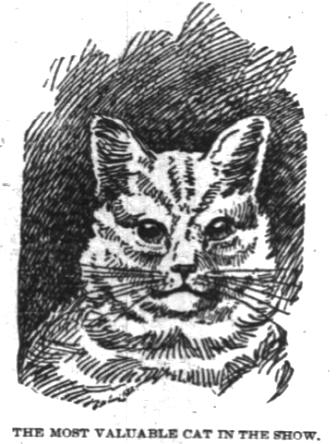
At the time, the very first National Cat Show was set to open at Madison Square Garden, an event for the city’s elite to show off their pampered purebreds. Hughes saw his chance. After a good wash and brush, he entered his dime-store cat into the show under the grand name “Nicodemus” and invented a ludicrous pedigree: “by Bowery, out of Dust-Pan, by Sweeper, by Ragtag-and-Bobtail.”
But Hughes didn’t stop there. He went all in.
At the show, poor Nicodemus was displayed on a silk cushion inside a gold-plated cage, surrounded by fresh roses. A woman in a nurse’s uniform attended to him around the clock. Each day, a footman would arrive with deliveries of chicken and ice cream from a famous caterer. Florists brought new bouquets daily. While the prized pets of the Astors and Morgans looked on, this scruffy cat from Hester Street was living the high life.
The stunt was a sensation. Spectators were baffled and delighted. Offers of up to $2,000 poured in for the cat advertised as “The $1,000 Cat Not for Sale.” In the end, Nicodemus actually won a $50 prize in the “brown and dark gray tom cats” category—mostly because he was the only cat entered in that class. It was a perfect punchline.
After the show, Nicodemus decided the fancy life wasn't for him. He escaped his attendant and vanished, only to reappear a few days later back at Hughes's factory on Centre Street. He clearly preferred the grit of old New York.

The story gets even better. A year later, Hughes entered the cat in another show. This time, the joke was on him: the judges discovered his “male” cat Nicodemus was actually a female, who promptly gave birth to two kittens. Undeterred, Hughes tried again in 1899. He entered the same cat, now named “Eulata,” under the alias "Nairb G. Sehguh" (Brian G. Hughes spelled backwards).

This time, the backstory was even more outlandish. “Eulata,” he claimed, was a mascot on the Spanish warship Vizcaya who survived its sinking by swimming to a U.S. vessel. For added flair, the cat was completely shaved except for her head and the tip of her tail. The judges quickly figured out the ruse when they decoded his backward name, but not before Hughes had once again stolen the show.
Having conquered the cat world, Hughes set his sights on another prestigious event: the National Horse Show at Madison Square Garden. In 1900, he purchased an old, worn-out streetcar horse for $11.50, saving her from being put out to pasture by the new electric trolleys. After two months of pampering at his country farm, the horse was ready for her debut.

He entered her under the name “Puldeka Orphan, by Metropolitan, dam, Electricity.” It was another coded joke that nobody noticed until after the show: “Pulled a car often, by Metropolitan. Damn electricity.”
His 18-year-old daughter, Clara, rode the horse in the arena. Everything went smoothly until people noticed something odd. Because the horse only knew the signals from her old job—one bell for "start," two for "stop"—Clara had a small bell hidden under the saddle to guide her. The odd ringing probably cost them the prize, but the sheer audacity of the prank earned Hughes yet another round of city-wide laughter.
Brian G. Hughes continued to pull pranks for much of his life, becoming so well-known that any mail addressed to “Brian G. Hughes, America” would find its way to his desk. When he died in 1924, New York didn't just lose a successful businessman; it lost its master jokesmith.
So next time you pass by Madison Square Garden, remember the tale of Nicodemus and Puldeka Orphan—the humble street animals who, for a few glorious days, hilariously upstaged the city’s elite. It’s a purr-fectly New York story of charm, wit, and not taking life too seriously.