Ever walked through Seward Park on the Lower East Side and wondered about the ghosts of the past? Well, let me tell you about one of the neighborhood's most unforgettable characters—a woman who ran a feline empire from a tiny, crumbling house right where the park stands today. Meet Rosalie Goodman, New York City’s original “crazy cat lady.”
And when we say "cat lady," we mean it. We're talking about 80 cats. Yes, you read that right. Eighty!
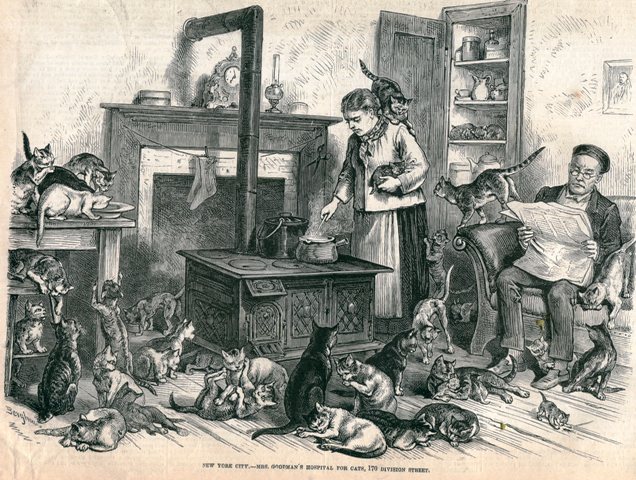
Picture this: It’s the 1870s, and the Lower East Side is a maze of crowded tenements and wooden shacks. In the middle of it all, at an address that no longer exists—170 Division Street—lived Rosalie Goodman. She was a Prussian immigrant and widow trying to support her four children by renting out rooms in her dilapidated, 17th-century home.
But Rosalie had a second, more unusual calling: she was the self-appointed guardian of every stray, sick, and forgotten cat in the neighborhood.

For nearly a decade, her ancient, three-story wooden house served as a feline sanctuary. It was a building that had already seen its share of history, but nothing compared to what Rosalie brought to it. A reporter from the New York Sun who visited in 1875 described a house practically bursting with cats—lounging on window sills, prowling in the courtyard, and peeking from every dark corner.
He painted a wild picture of the scene inside: "As the visitor clambers up the dark, cobwebbed staircases, evidence of cats are perceptible on every hand; cats yellow, cats black, golden and dingy; cats tawny, white, and dubious… cats of every description skulk in the black nooks or rush out and disappear in sudden panic." He cheekily added that a "voluminous cloud of feline exhalation" wafted permanently down the stairs. You can just imagine the smell!
So how does someone become the patron saint of eighty Lower East Side cats? For Rosalie, it all started with one.
A Kitten Named Tiger
Believe it or not, Rosalie used to be afraid of cats. That all changed when she found a tiny, homeless kitten on the street. She took him in, nursed him back to health, and named him Tiger. Soon, it seemed Tiger had spread the word to all his feline friends on Essex Street that 170 Division Street was the place to be for a good meal and a warm bed.

But the story takes a tragic turn. One day, someone stole Tiger and left him to starve in a basement. Rosalie was heartbroken. She told a reporter, "I found nothing but his bones, and I buried him, and then I made up my mind that I’d take care of all the cats I could."
Fueled by grief and compassion, she declared war on animal cruelty. "It’s only people without sense or heart that would turn a helpless animal out in the cold," she said. "Somebody must look out for them. I don’t love the cats yet, but I pity them."
And look out for them she did. Rosalie spent about $1.50 a day—a significant sum at the time—on the best sausages and beefsteaks the Bowery had to offer, cooking up warm dinners for her furry boarders. She transformed a room on the third floor into a bedroom for the cats who preferred a cozy night in over prowling the rooftops.
The Talk of the Town
Naturally, a house with 80 cats didn't go unnoticed. The local kids called her "Catty Goodman." Her human tenants knew the golden rule: mess with the cats, and you're out. One told a reporter, "If any of her tenants interferes with the rights of her cats, or abuse them, he may expect to leave his room at the earliest date."
Frustrated neighbors complained to the Board of Health, hoping to shut her down. But after an inspection, the officers found she wasn't breaking any laws. The cats were looked after, and her heart was in the right place. The law was on Rosalie’s side.
She also became a minor celebrity, attracting a parade of newspaper reporters. While she was initially open to sharing her story, she eventually grew tired of the attention. When a reporter from The Daily Graphic tried to barge in in 1878, she famously yelled, "Now, you get out! My lawyer say to me no reporter have any right to come in my house, and if so I shall shoot him or push him down stairs or take my broomstick." You tell 'em, Rosalie!
The End of an Era and the Birth of a Park
By 1880, Rosalie’s time on Division Street came to an end. She moved uptown to 19th Street with her family. A few years later, her legendary cat house was torn down, replaced by a new brick tenement. But the area was about to undergo an even bigger transformation.

In 1897, the city began a massive urban renewal project. Block after block of old, decaying tenements—including the one at 170 Division Street—were condemned and demolished to create a green space for the overcrowded neighborhood. After years of delays, the site was finally developed into Seward Park, which officially opened in 1903 as the first permanent, municipally built playground in the United States.

While the park was a blessing for residents, it was a disaster for the local cat population. Without Rosalie's sanctuary, the strays were on their own. Tragically, the new park even hosted a "dumping station" where people could drop off stray cats to be collected by the SPCA for euthanization. It was a cold, institutional solution to a problem one woman had tried to solve with simple, albeit chaotic, compassion.
So next time you’re strolling through the Lower East Side, take a walk through Seward Park. Find a nice bench, and take a moment to imagine the world that was here before: a creaky old house, the constant sound of purring, and a tough, kind-hearted woman who created an unlikely haven for the city’s most vulnerable creatures.