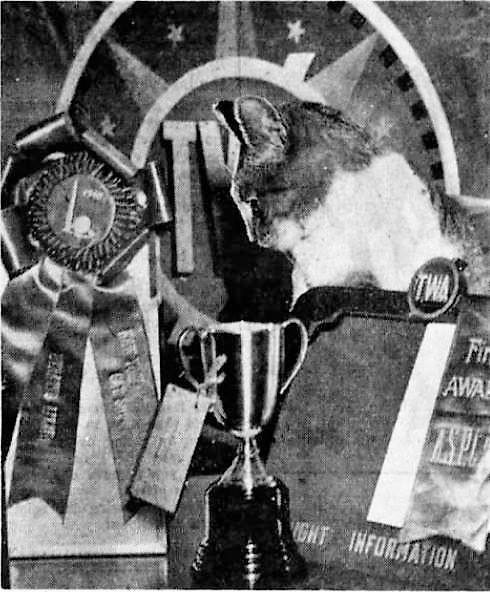
Meet Strato Lizzie, the mascot of the Transcontinental and Western Air (TWA) pilots.

Her story begins not in New York, but in a Los Angeles alley. Found as a tiny kitten behind an ash can, she was rescued by a pilot who discovered she had an unusual tolerance—even love—for flying. After being passed from pilot to pilot like a furry message, she finally landed at the brand-new LaGuardia Field in 1940 and into the hearts of the TWA crew.
The pilots officially adopted the six-month-old cat, making Hangar No. 6 her home base. And what a home it was. When she wasn't jet-setting, Strato Lizzie dined on daily meals of turkey and veal from the flight commissary. You read that right. This cat ate better than most New Yorkers.

But she rarely stayed grounded for long. Strato Lizzie became a seasoned traveler, often hitching rides in the cockpit on transcontinental flights. It’s said she crossed the United States at least six times, logging over 100,000 air miles in just 18 months. She also became a show-cat champion, flying to competitions in Chicago, Boston, and Minneapolis, and collecting ribbons along the way.
Of course, fame comes with its own drama. In January 1941, just as she was being prepped for the prestigious Atlantic Cat Club show at Manhattan’s Hotel Taft, Strato Lizzie vanished. Panic ensued at the hangar. TWA sent messages to stations as far west as Kansas City, asking, "Have you seen our cat?" A TWA publicist dryly told the press, “Need I add that this is an unfortunate occurrence.”
The show went on without its feline star. But a few days later, she reappeared, casually scratching at the door of Hangar 6 as if she’d just been out for a stroll. No one ever found out where she’d been.

Her mysterious disappearance only boosted her star power. Soon after, Hollywood came calling. A Paramount talent scout cast her in the 1941 film “Forced Landing,” starring Richard Arlen and a young Eva Gabor. But Strato Lizzie had another surprise in store. Production was reportedly held up when, right there on the movie set, she gave birth to four kittens!
Life returned to a new normal, but the peace didn't last. A year after her first vanishing act, in January 1942, Strato Lizzie went missing again. This time, it felt different. The cries of "Here kitty, kitty" echoed through the TWA offices and hangars for weeks. Newspapers across the country ran stories about the missing mascot, and the ASPCA even joined the search.
Offers to replace her poured in from sympathetic New Yorkers. But the pilots held out hope. Finally, on February 13, 1942, TWA officially abandoned the search. Strato Lizzie, the high-flying feline phenomenon, was gone for good.

But the legend had to live on. That same day, TWA introduced her successor: Strato Lizzie Jr., a six-month-old lookalike gifted by an anonymous New Yorker. The new mascot gamely took up the mantle, even posing in a custom-made Easter bonnet from famed hat designer Lilly Daché, though she probably wasn't thrilled about it.
So next time your flight is delayed at LaGuardia, wander over toward the historic Marine Air Terminal (Terminal A). Look out at the tarmac and imagine a little cat, once the queen of the skies, who called this airport home. Whether the original Strato Lizzie simply retired to a quiet life in Queens or hopped a plane to one last, unknown destination, her story remains one of the most charming in New York City's history—a true tale of a stray who literally flew to the top.