You read that right. This is the story of one of New York's most wholesome and unbelievable friendships.

Back at the turn of the 20th century, the city’s General Post Office wasn’t the sleek building you know today. It was a grand, ornate behemoth nicknamed “Mullett’s Monstrosity” that stood right in City Hall Park. And it had a serious mouse problem. The solution? Dozens of cats were officially “employed” by the U.S. Post Office, complete with a budget for milk and liver, to keep the vermin in check.
This feline squad had a few human helpers, but none were as devoted as Gustave Fersenheim.
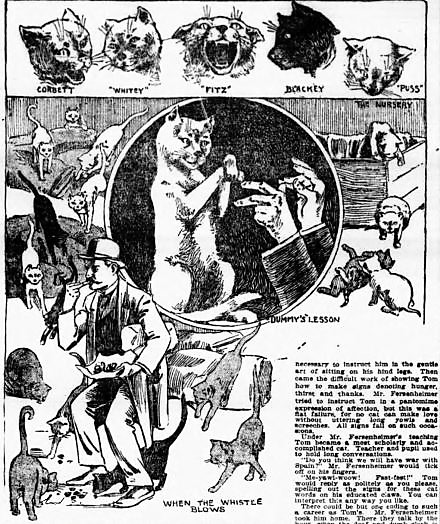
Gustave was a quiet, elderly postal clerk who was also deaf. In 1901, he was 78 years old and had worked at the post office for over 30 years. While his official job was sorting mail, his true passion was caring for the cats. He was so dedicated that he commuted every morning from his apartment in the South Bronx, leaving before 5 a.m., just to make it to Lower Manhattan in time to feed the cats before his shift started.

Gustave was a bit shy about his affection for his feline friends, often trying to tend to them before too many of his coworkers arrived. But everyone knew he was the cats’ biggest champion. He couldn’t bear the thought of the kittens being drowned (a grim but common practice at the time), so he constantly pestered his fellow clerks to adopt them—a task they found both annoying and endearing.
Then one day, Tom the cat came into his life.
Tom was a handsome gray cat, but he had a strange habit. He would blissfully snooze on the loading docks, completely unfazed by the clattering hooves and rumbling wheels of the mail wagons. The other cats would scatter, but Tom wouldn’t move a muscle. Clerks would rush over, shouting and waving their arms, thinking the cat was just stubborn. But Gustave, observing their frustrated faces, realized the truth: the cat couldn’t hear them.
Tom was deaf, just like him.

A bond was instantly formed. Delighted to have found a “kindred spirit,” Gustave adopted Tom on the spot, bringing the cat to his desk for special treats of beef. Soon, Tom was following Gustave around like a loyal puppy. Seeing a spark of intelligence in the cat, Gustave began Tom’s official education.
First, he taught him to sit up on his hind legs. Then came the real breakthrough. He began teaching Tom simple signs. A certain gesture meant "I'm hungry," another meant "I'm thirsty," and a third was for "thank you."
According to news reports from the time, Tom became “a most scholarly and learned cat.” The man and cat would have long “conversations,” with Gustave asking questions with his fingers and Tom responding with what one reporter playfully described as meows and paw gestures that “you can interpret any way you want.” Gustave decided Tom was far too polite and educated for the rough-and-tumble life of a rat catcher, so he took him home to live with him full-time.

Sadly, this unique friendship wasn’t destined to last forever. In August 1901, Gustave fell ill and passed away at the age of 78. His last reported words were a simple, spoken phrase: “I am done.”
His death sent a wave of grief through the post office—especially among its four-legged employees. A Pittsburgh newspaper reported, “There is sorrow and gloom in the hearts of the forty cats which are employed by Uncle Sam to keep rats out of the post office building. Gustave is gone, and the cats, every one of which loved him, refuse to be comforted.”
Gustave Fersenheim was laid to rest next to his first wife in Woodlawn Cemetery in the Bronx, a place you can still visit today. His legacy is not one of wealth or power, but of a quiet, profound kindness that bridged the gap between species and silence.
So the next time you find yourself near City Hall Park, take a moment. Look at the space where that "monstrous" old post office once stood, and imagine a gentle, elderly man having a silent conversation with his best friend, a very scholarly deaf cat named Tom.